Women's Livelihood
From flowers to financial freedom — the sweet success of Maa Shakti SHG
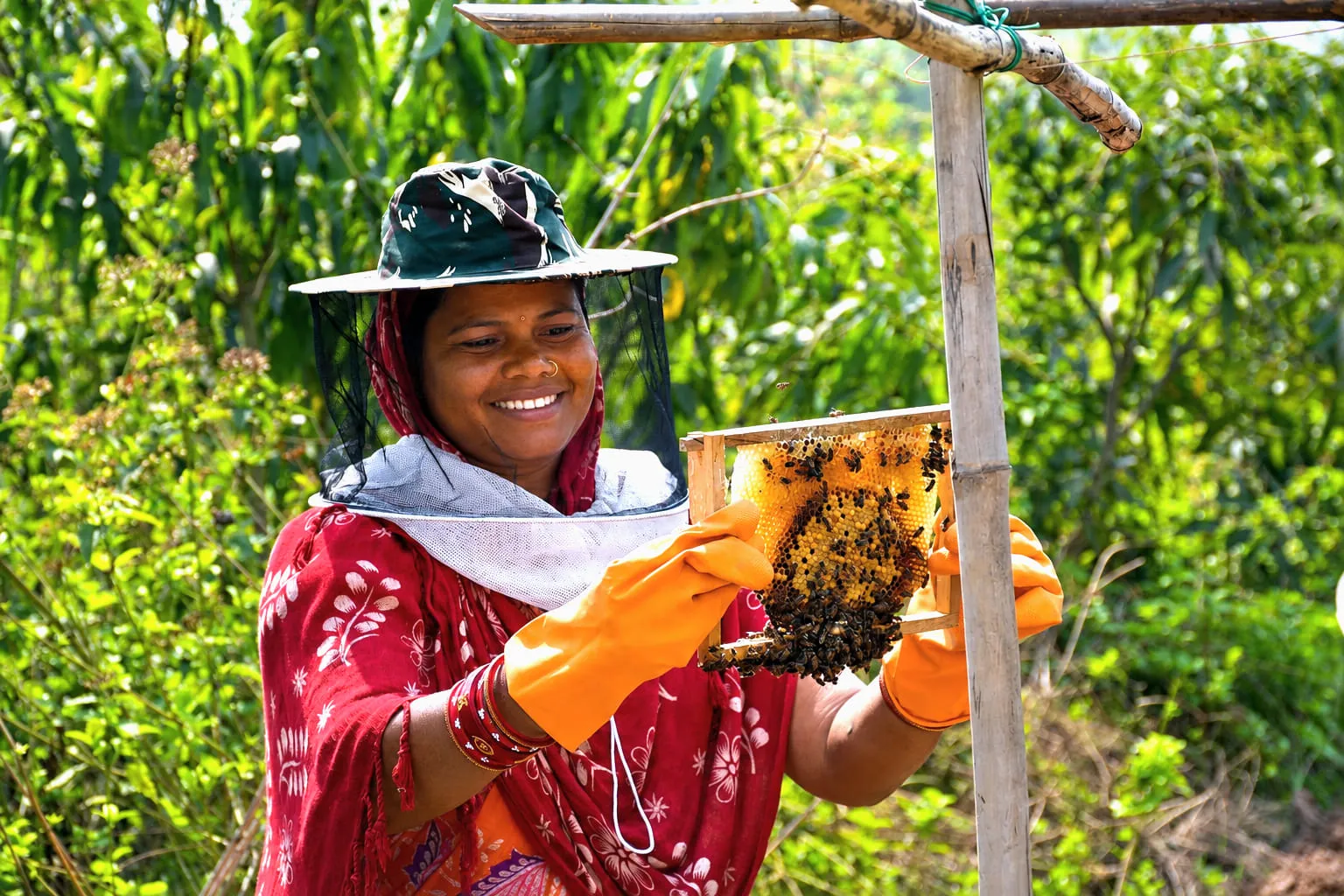
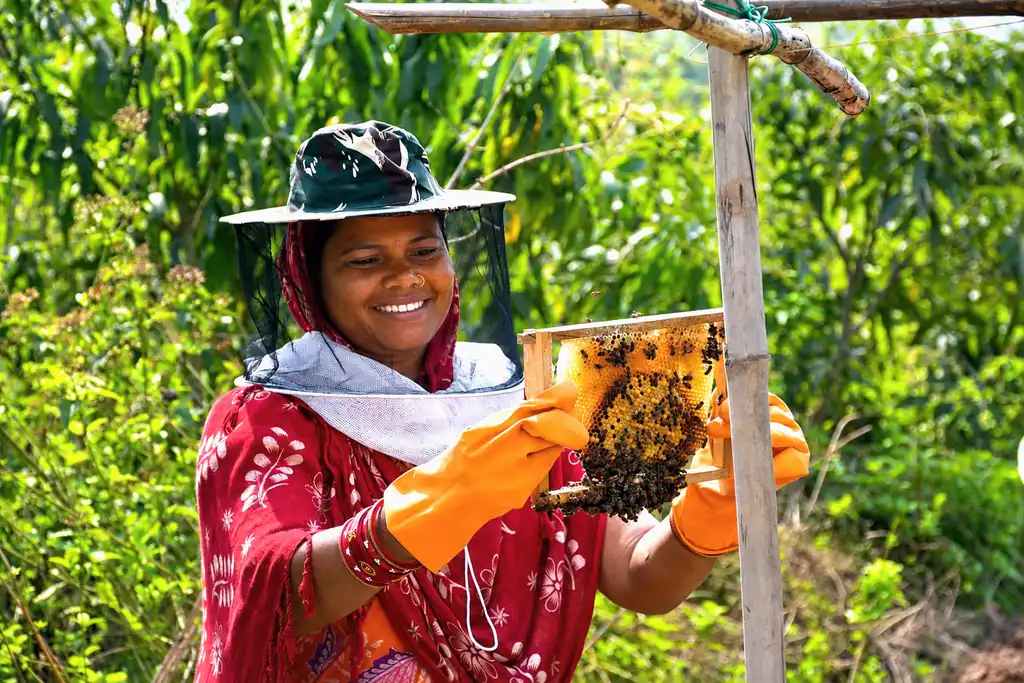
A member of Maa Shakti SHG in a beekeeper's veil holding up a frame of comb from one of the group's hives
- Honeybee boxes
- 15Honeybee boxes
- Honey per cycle
- 105–135 kgHoney per cycle
- Potential income per cycle
- ₹94,500–₹1.35LPotential income per cycle
Fifteen bee boxes, training every three weeks and a market that pays ₹900 a kilo. The women of Maa Shakti SHG have built a livelihood that does not wait on the monsoon.
In Baddhara village, work for women meant small-scale farming and whatever seasonal labour was going. The self-help groups had the appetite to earn. What they did not have was an activity that fitted around the farm and the household and still paid.
Why beekeeping
Apiculture is unusual among rural enterprises: the investment is small, the return is high, and the bees pay a second dividend by pollinating the crops already growing around the village. It needs almost no land, and the work can be picked up and put down between other jobs.
Under the Integrated Village Development Programme, supported by the LTIMindtree Foundation, AJKA gave the Om Sai PG Group — managed by Maa Shakti SHG — 15 honeybee boxes. Equipment on its own tends to sit idle, so the boxes came with a programme of support:
- Orientation in scientific beekeeping practice
- Hands-on training every 20 to 25 days
- Continuing guidance on hive management, extraction and maintenance
The point was not to hand over assets. It was to leave the group able to run them.
The numbers
Each box yields 7–9 kg of honey per cycle, so all 15 together produce 105–135 kg. At the ₹900–₹1,000 per kilo the local market pays, that is between ₹94,500 and ₹1,35,000 a cycle — a genuinely new income stream, and one with obvious room to grow.
The returns are not only financial:
- Decision-making power. Money the group has earned itself changes who gets a say at home.
- Skills. Regular training has built real technical knowledge, and the confidence that comes with it.
- Better harvests. Natural pollination has lifted yields on nearby fields.
- Collective capacity. The group now manages an enterprise together.
Earlier, we had very limited income sources. Now, through honey cultivation, we will earn together and learn new skills. It has given us confidence.
— Pabitra Khamari, Maa Shakti SHG
What comes next
With continued training the boxes will keep producing for years. The group is now looking at three things: adding more boxes, branding and packaging their own honey, and reaching larger markets where the price is better.
It is a small intervention, well supported. That combination is what turns dependence into self-reliance.