- Villages covered
- 123Villages covered
- Farmers reached
- 1,503Farmers reached
- Gram Panchayats
- 32Gram Panchayats
- Millet crop coverage achieved
- 829.44 haMillet crop coverage achieved
- Procurement — Lakhanpur / Jharsuguda
- 100% / 96.38%Procurement — Lakhanpur / Jharsuguda
During FY 2025-26, the programme covered 55 villages and 718 farmers in Jharsuguda Block, and 68 villages and 785 farmers in Lakhanpur Block.
AJKA has been implementing the Odisha Millets Mission — renamed Shree Anna Abhiyan in 2025-26 — in Lakhanpur and Jharsuguda Blocks since 2022-23, supported by the Department of Agriculture, Government of Odisha.
The challenge
Millets are closely linked to climate-resilient agriculture, household nutrition and livelihood security, yet their sustained revival requires more than increasing cultivation alone.
Farmers need access to improved agronomic practices, quality seed systems, capacity building, procurement mechanisms and stronger market opportunities. At the household and community level, millet consumption also needs to be strengthened so that production gains translate into better nutrition and long-term demand.
Shree Anna Abhiyan addresses these interconnected areas by working across production, consumption, nutrition awareness, farmer capacity building, value addition and market development.
How the programme works
Sustainable millet production
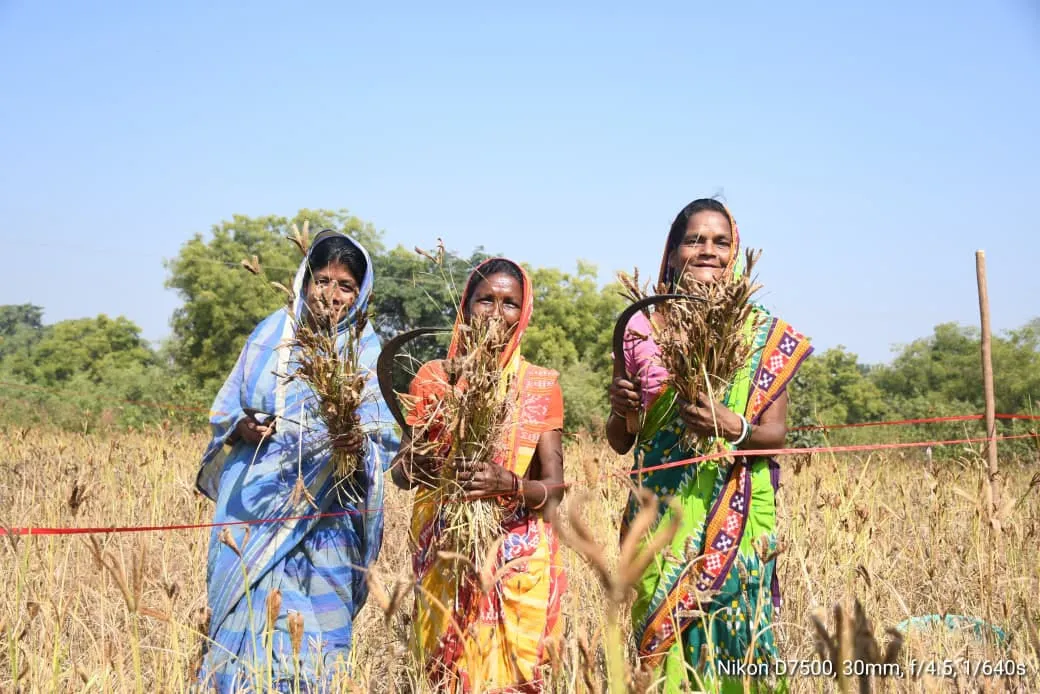
The programme supports farmers to improve productivity through training, field demonstrations and improved agronomic practices.
During FY 2025-26, the programme conducted training on the System of Millet Intensification, supported bio-input activities, organised field demonstrations and carried out crop-cutting exercises for monitoring and documentation.
Crop coverage during the year reached 385.60 hectares in Jharsuguda Block against a target of 580 hectares, and 443.84 hectares in Lakhanpur Block against a target of 690 hectares.
Farmer capacity & Community Resource Persons
Strengthening local technical capacity is an important part of the programme.
Community Resource Persons and progressive farmers received training on agronomic practices, farmer data collection, implementation planning and regular follow-up. During the year, all 12 planned CRP training activities were completed.
This approach takes technical knowledge closer to farmers while building local capacity for continued programme implementation.
Millet consumption & nutrition awareness
The programme also works to strengthen demand for millets by promoting their consumption at household and community levels.
Awareness campaigns aimed at increasing household millet consumption ran alongside workshops, campaigns and food festivals involving ICDS and PRI representatives, promoting millet-based food systems in both rural and urban settings. All ten planned millet-promotion events were completed during FY 2025-26.
Seed systems & sustainable production
The programme strengthens community-based production systems through Seed Village initiatives and organic certification. During FY 2025-26, the planned 10 hectares under the Seed Village Programme and 80 hectares under organic certification were achieved in full.
These interventions support the conservation and promotion of millet varieties while encouraging more sustainable production systems.
Procurement & market linkages
Improved production is connected with procurement and market systems so that farmers have stronger incentives to continue millet cultivation.
During FY 2025-26 procurement reached 1,500 against a target of 1,500 in Lakhanpur — 100% — and 1,156.50 against a target of 1,200 in Jharsuguda, or 96.38%.
The programme also seeks to strengthen millet value addition, post-harvest processing, market access and millet-based enterprises.
What we have learned
The FY 2025-26 implementation shows that millet promotion works best when production, farmer capacity, procurement, consumption and community awareness move together.
Training and field demonstrations strengthen agronomic practices, while community resource persons create a local support system for farmers. Awareness campaigns, food festivals and engagement with PRI and ICDS stakeholders help build demand beyond the farm.
The programme’s performance also demonstrates the importance of pairing production support with procurement and institutional mechanisms, so that farmers have a clearer pathway from cultivation to market.